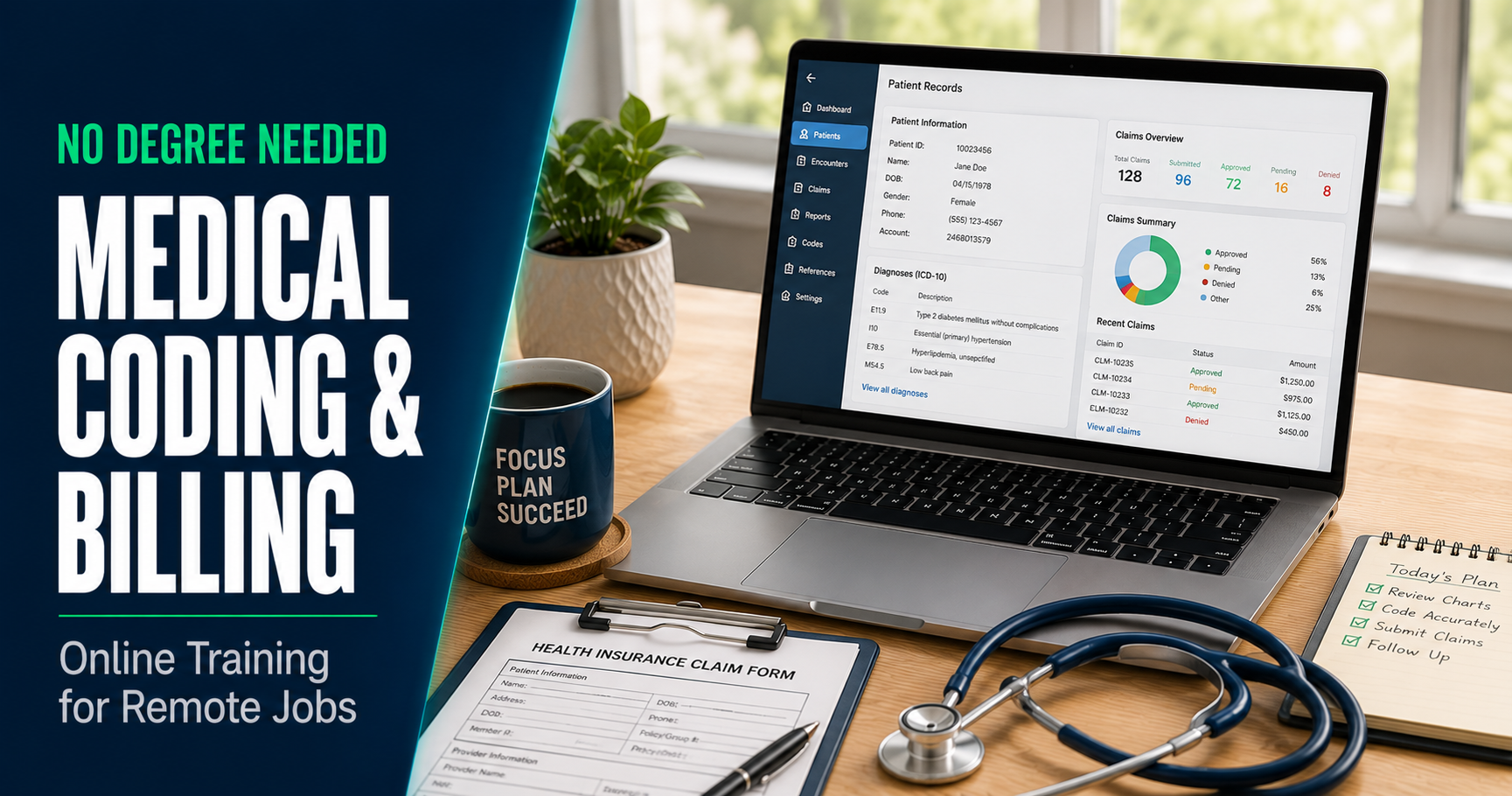
Medical coding and billing is one of the most popular routes into a remote healthcare career, and for good reason. You can train online in months rather than years, you do not need a medical degree, and a huge share of the jobs are work-from-home. If you are detail-oriented and want stable, remote-friendly work in a growing field, the right medical coding and billing training can get you there.
But there is a catch most articles gloss over, and it can cost you time and money if you do not understand it: a cheap online course teaches you the skills, but the credential employers actually want comes from passing a separate, official certification exam.
This guide compares the top 5 programs for beginners, explains the difference between the ICD-10 and CPT coding systems you will work with daily, and lays out the honest path from beginner to hired.
Disclosure: This post contains affiliate links for Udemy, edX, and Coursera. If you enroll through one, I may earn a small commission at no extra cost to you. I only recommend programs I believe are genuinely worth it.
Quick comparison: the top 5 medical coding & billing programs
| Program | Price | Duration | Best for |
|---|---|---|---|
| The Complete US Medical Billing & Coding Course (Udemy) | ~$15 to $25 on sale | Self-paced | An affordable, all-in-one foundation |
| Medical Coding ICD-10 / CPC Training (Udemy) | ~$15 to $25 on sale | Self-paced | Focused exam-topic practice |
| AAPC Medical Biller Professional Certificate (Coursera) | ~$49/month | A few months | Official AAPC-built billing training |
| Medical Billing & Coding Fundamentals (Coursera) | ~$49/month | A few months | A structured beginner specialization |
| edX Medical Coding Courses | Varies (audit free; certificate paid) | A few weeks to months | University-affiliated foundational learning |
Before we dig into each, you need to understand two things that shape every decision here: the certificate-versus-certification gap, and the difference between coding and billing.
The most important thing: a course is not a certification
Here is what trips beginners up. The credentials employers look for in this field come from professional bodies, mainly the AAPC (American Academy of Professional Coders) and AHIMA (American Health Information Management Association).
The most popular entry credential is the AAPC’s Certified Professional Coder (CPC). For billing, it is the Certified Professional Biller (CPB). AHIMA offers the CCA and CCS.
A $20 Udemy course does not make you a CPC. It teaches you the material and helps you prepare, but you still have to register for and pass the official exam to earn the credential.
And that exam is a real expense: the CPC exam runs about $399 for one attempt. Full accredited training bundles from AAPC itself can cost a few thousand dollars.
So the smart play for a budget-conscious beginner is to learn the material affordably (Udemy, edX, or Coursera), then pay for and pass the official certification exam separately.
That gets you the recognized credential for far less than an all-in-one accredited bootcamp. Keep that path in mind as you read the options below.
What is the difference between medical coding and billing?
These two jobs are related but distinct, and many small offices combine them into one role.
A medical coder reads a patient’s medical records and translates the diagnoses and procedures into standardized codes. A medical biller takes those codes, prepares and submits insurance claims, and manages the back-and-forth of getting the provider paid (the revenue cycle).
Coding is about accuracy and classification, billing is about claims and reimbursement. Training programs often teach both, which is why the career is usually marketed together as “medical billing and coding.”
What is the difference between ICD-10 and CPT codes?
This is the question that confuses almost every beginner, so here is the simple version.
ICD-10-CM codes describe the diagnosis: the “why.” They tell the story of what is wrong with the patient, the condition or reason for the visit. There are over 68,000 of these codes, which is why this system takes real study.
CPT codes describe the procedure: the “what was done.” They record the services and procedures the provider performed during the visit. CPT codes are maintained by the American Medical Association.
A simple way to remember it: ICD-10 is the diagnosis (why the patient came in), and CPT is the procedure (what the provider did about it). You will also encounter HCPCS Level II codes, which cover supplies, equipment, and certain services not included in CPT.
A good training program teaches all three, because real claims use them together. Any course you choose should clearly cover ICD-10-CM, CPT, and HCPCS, because that combination is the daily work.
The 2 best Udemy courses (affordable foundation)
Udemy is the cheapest way to learn the material and confirm you enjoy this work before investing in an exam. The list prices look high, but courses are almost always on sale for around $15 to $25, and you keep them for life.
1. The Complete US Medical Billing & Coding Course
This is a strong all-in-one starting point. It covers medical terminology and anatomy, ICD-10, CPT, and HCPCS codes, SOAP notes, compliance, and billing workflows, with quizzes, case studies, and exercises that build toward the CPC exam. It is comprehensive, hands-on, and recently updated, which makes it an excellent first course for a complete beginner.
2. Medical Coding ICD-10 / CPC Training
For more focused practice on the coding side specifically, a dedicated CPC-prep or ICD-10 essentials course drills the diagnosis and procedure coding skills the exam tests most heavily. Pair it with course #1 for both breadth and depth, still for well under the cost of a single textbook.
The 2 best Coursera options (structured and credential-aligned)
Coursera costs more, around $49 a month, but gives you structure, accountability, and in one case, official AAPC-built content.
3. AAPC Medical Biller Professional Certificate
This is the standout structured option because it is built by AAPC itself, the same body that issues the credentials. It is designed to launch you toward the Certified Professional Biller (CPB) credential, with practical, hands-on work using real, redacted medical records.
You will learn the full revenue cycle, claim submission, insurance verification, denials and appeals, and key regulations like HIPAA. Note that you will need the CPT, ICD-10-CM, and HCPCS code books to complete it, which is the same material you would need on the job anyway.
4. Medical Billing & Coding Fundamentals
If you want a gentler, broader on-ramp before committing to exam-specific prep, a fundamentals specialization on Coursera walks you through the core concepts in a structured, beginner-friendly sequence.
It is a good way to build confidence and decide whether coding or billing appeals to you more. For a fuller comparison of how these two platforms differ on price and value, see our guide on Coursera vs Udemy for remote job skills.
5. edX Medical Coding Courses (university-affiliated)
edX rounds out the list for learners who prefer university-backed content. It offers individual medical coding courses and healthcare programs from colleges and universities, which is ideal if you value academic structure or want to eventually fold this into a broader healthcare or associate-degree path.
You can audit many courses for free and pay only if you want the certificate. edX is better thought of as a place for foundational, university-affiliated learning than as a single flagship certification, so plan to pair it with an official AAPC or AHIMA exam when you are ready to get credentialed.
How to choose a medical coding and billing training program
With several solid options, here is how to pick the right medical coding and billing training for your situation:
- On a tight budget or just testing the field? Start with a Udemy course. Cheap, lifetime access, and enough to learn the fundamentals and decide if this is for you.
- Want structure and official content? The AAPC certificate on Coursera is the strongest credential-aligned pick.
- Prefer university-backed learning? edX, especially if you might pursue further healthcare education later.
- Whatever you choose, budget separately for the official CPC or CPB exam, since that credential is what gets you hired.
Make sure any program clearly covers ICD-10-CM, CPT, and HCPCS, and ideally aligns with an AAPC or AHIMA certification, since accreditation is what employers trust.
How much do medical coders and billers make?
Realistic numbers matter. Medical coders and billers typically earn somewhere in the range of $40,000 to $70,000 a year, with the federal data for medical records specialists landing around $50,000.
Entry-level pay starts lower, often in the low-to-mid $40,000s, and climbs with certification and experience. Experienced and specialized coders (for example, those who code for oncology or cardiology, or who earn risk-adjustment credentials) can reach $60,000 to $80,000 and beyond.
Certified professionals consistently out-earn non-certified ones, which is the entire argument for paying for that exam.
Can you do medical coding and billing from home?
Yes, and it is one of the field’s biggest draws. A large share of coding and billing work is done remotely, because the entire job is reviewing digital records and submitting electronic claims.
Many employers hire remote coders and billers, and some experienced professionals even run their own home-based billing businesses. It is one of the more genuinely work-from-home-friendly healthcare careers, which is why it shows up so often on lists of remote jobs for beginners.
Frequently asked questions
Do I need a certification to get a medical coding job?
In practice, yes for most roles. Employers strongly prefer a recognized credential like the AAPC CPC or an AHIMA certification, especially for remote positions. A course alone teaches you the skills, but the certification is what proves them to employers.
Which certification is best for beginners?
The AAPC Certified Professional Coder (CPC) is the most widely recognized entry credential for coding, and the Certified Professional Biller (CPB) for billing. AHIMA’s CCA is another solid beginner option. Choose based on whether you lean toward coding or billing.
How long does it take to become a medical coder?
Most people get job-ready in about six months to a year, depending on pace and the program. Affordable self-paced courses let you move faster, while structured programs add accountability.
Is medical coding hard to learn with no experience?
It is learnable from scratch, but it does require real study, especially memorizing how the ICD-10, CPT, and HCPCS systems work. Strong attention to detail matters more than any medical background.
Can I really work from home as a medical coder?
Yes. Remote coding and billing roles are common, and the work suits home offices well. A reliable computer, good internet, and your certification are the main requirements.
Disclaimer: Course prices, exam fees, and salary figures are based on publicly available information as of 2026 and can change, so confirm current pricing on the official Udemy, Coursera, edX, AAPC, and AHIMA pages before enrolling. Salaries vary by certification, experience, location, and employer and are not guarantees of income. This article is educational and not financial or career advice. It contains affiliate links, and I may earn a commission if you enroll through them at no additional cost to you.
Ready to start? Learn the foundations affordably with a medical billing and coding course on Udemy, or take the structured route with the AAPC Medical Biller Certificate on Coursera, then sit for your official certification exam.