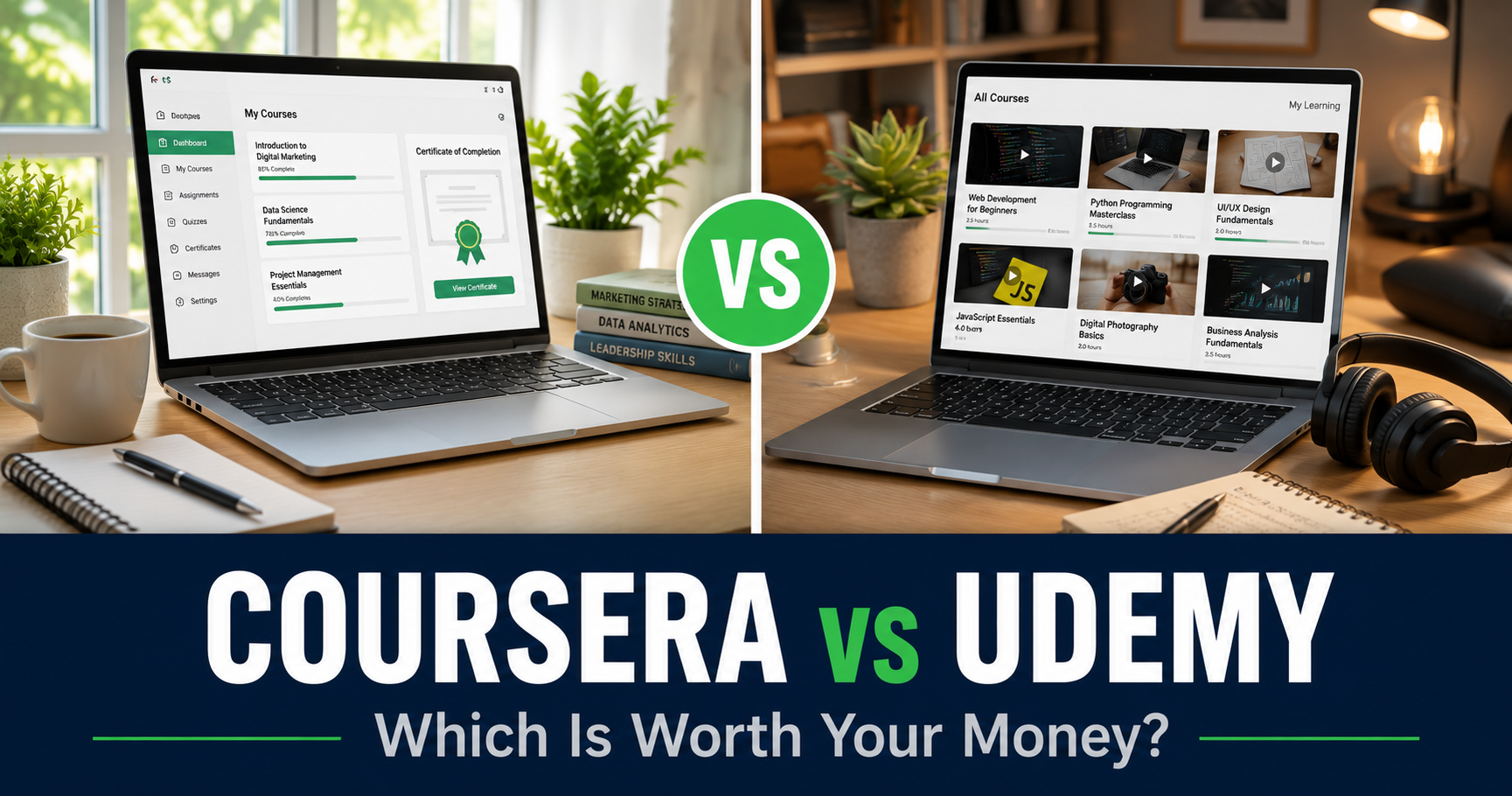
If you are trying to build skills for a remote job or a work-from-home career, two names come up again and again: Coursera and Udemy. They are both huge, both popular, and both promise to make you more hireable.
But they work in completely different ways, they charge in completely different ways, and picking the wrong one for your goal can cost you money and time.
This is a straight, honest comparison. We will break down how each one actually charges you, which certificate carries more weight with employers, and which platform is worth your money, depending on what you are trying to do.
Disclosure: This post contains affiliate links for both Coursera and Udemy. If you sign up through one of them, I may earn a small commission at no extra cost to you. I have no reason to push you toward one platform over the other, so the breakdown below is genuinely how I would advise a friend.
Coursera vs Udemy at a glance
| Factor | Udemy | Coursera |
|---|---|---|
| Pricing model | Pay once per course | Monthly subscription |
| Typical cost | ~$10 to $20 on sale, lifetime access | ~$49/month per certificate (3 to 6 months) |
| Certificate type | Certificate of completion | University and company-backed credentials |
| Who makes the courses | Independent instructors (open marketplace) | Universities and companies (Google, IBM, Meta, etc.) |
| Best for | Learning a specific skill fast and cheap | Structured learning and resume-worthy credentials |
Now, let us unpack what those differences actually mean for your wallet and your career.
What is the difference between Coursera and Udemy?
The core difference is curated versus open.
Coursera is a curated platform. It partners with universities and major companies like Google, IBM, and Meta to build structured programs, and the content is reviewed before it goes live. You get organized learning paths and credentials with a recognizable name attached.
Udemy is an open marketplace. Almost anyone can create and sell a course, which means there is an incredible variety (hundreds of thousands of courses on every topic imaginable) but also inconsistent quality.
A great Udemy course can be a life-changing value for $15, but you have to read the reviews carefully, because the platform does not vet instructors the way Coursera vets its partners.
A simple way to remember it: Udemy is skill-first, Coursera is credential-first.
How much do Coursera and Udemy cost?
This is where the two platforms differ the most, and understanding it will save you money.
Udemy uses a pay-per-course model. You buy a course once and own it for life, with no subscription and no deadlines. List prices look high, often $20 to $200, but here is the insider tip: Udemy runs near-constant sales that drop most courses to around $10 to $20.
If you ever see a Udemy course at full price, wait a few days, because a sale is almost always coming. There is also an optional Udemy Personal Plan subscription (roughly $20 to $35 a month) if you want library access to many courses at once, but most beginners are better off just buying the one or two courses they need on sale.
Coursera uses a subscription model. Most of its valuable content, the Professional Certificates and Specializations, costs around $49 a month, and since these typically take three to six months, your total cost lands somewhere around $150 to $300, depending on how fast you go.
The faster you finish, the less you pay. If you plan to take several programs, Coursera Plus (about $59 a month or $399 a year) unlocks unlimited access and includes a certificate for every course you complete.
Coursera also lets you audit many courses for free if you only want the knowledge and not the certificate, and it offers need-based financial aid that can reduce or waive the fee entirely.
The bottom line on cost: Udemy is cheaper for learning one specific skill. Coursera costs more but bundles in a recognized credential. The speed angle matters too, since Coursera rewards you for finishing quickly, while Udemy charges the same whether you finish in a week or never start.
Which platform carries more weight on a resume?
This is the question that actually matters for landing a remote job, so let us be honest about it.
Coursera credentials carry more weight with employers. When you finish a Google or IBM Professional Certificate on Coursera, you are putting a name an employer recognizes on your resume, backed by a company or university.
A Udemy certificate, by contrast, is a certificate of completion from an open marketplace. It proves you finished a course, but it does not carry institutional backing, and most hiring managers know that anyone can publish on Udemy.
Now the important nuance, because this gets oversold everywhere: a certificate alone does not get you hired. Skills, proof of work, and consistency get you hired. A Udemy course that genuinely teaches you a tool an employer needs can be more valuable than a fancy certificate you cannot apply.
So the real answer is this: use Coursera when you want a credential that signals competence to employers, and use Udemy when you want to actually build a specific skill quickly and cheaply. The certificate opens the door, but your demonstrated ability is what walks you through it.
Is Udemy or Coursera better for beginners?
For an absolute beginner on a budget who wants to test the waters, Udemy is the easier on-ramp. It is cheap, you own the course forever, and there is no subscription clock ticking while life gets in the way. You can learn a specific skill, like how to use a particular software tool, for the price of a lunch.
For a beginner who already knows the career they want and is ready to commit, Coursera is the stronger investment. The structured deadlines actually help you finish (open-ended Udemy courses have famously low completion rates because nothing pushes you), and you come out with a credential you can put to work.
Are Udemy and Coursera certificates worth it?
Both are worth it for the right purpose, and worthless for the wrong one.
A Udemy certificate is worth it as a learning receipt and a confidence builder, not as a resume centerpiece. Its real value is the skill you gained, not the certificate itself.
A Coursera professional certificate is worth it when it is from a recognized partner and relevant to the job you want. Those credentials genuinely strengthen a resume and can be the thing that gets you an interview, especially for a career change with no prior experience.
For a concrete example of each: the Intuit bookkeeping certificate on Coursera is the kind of structured, employer-recognized credential that justifies the subscription cost, while a focused Udemy course is perfect for picking up a single in-demand tool.
If you want to see how this plays out for a specific career, our guide to the top virtual assistant training courses compares specific budget Udemy courses against structured Coursera programs side by side.
Which should you choose? The honest verdict
Stop thinking of it as either-or. The smartest strategy in 2026 is to use each platform for what it does best:
- Use Udemy to build practical skills fast and cheap, learn specific tools, and fill gaps, all for a few dollars per course with lifetime access. Browse Udemy courses here.
- Use Coursera when you want a structured path and a recognized credential that strengthens your resume for remote employers. Explore Coursera certificates here.
A realistic game plan for someone breaking into remote work: start on Udemy to learn a skill cheaply and confirm you actually enjoy it, then invest in a Coursera professional certificate to credential yourself once you know the direction you want to go. That sequence gives you the lowest-risk start and the strongest finish, and it costs less than committing blindly to either platform alone.
Want to see this strategy applied to a real skill? Check out our beginner guides to copywriting courses, virtual assistant training, and bookkeeping certifications to see exactly which Udemy and Coursera options fit each path.
Frequently asked questions
Is Coursera or Udemy cheaper?
Udemy is cheaper for a single course, often $10 to $20 on sale, with lifetime access. Coursera costs more (around $49 a month for a certificate program) but includes a recognized credential and lets you audit many courses for free.
Do employers prefer Coursera or Udemy certificates?
Employers generally give more weight to Coursera credentials because they are backed by universities and companies like Google and IBM. Udemy certificates show course completion but carry no institutional backing. That said, demonstrated skill matters more than either certificate.
Can I get a job with just a Udemy or Coursera course?
A course can absolutely help you build the skills to get hired, but no certificate guarantees a job on its own. What lands the job is the skill, a portfolio or proof of work, and consistent application. Use the course to build real ability, not just to collect a certificate.
Is Coursera Plus worth it?
It is worth it if you plan to complete more than one or two certificate programs, since the unlimited annual access can cost less than paying month-by-month for several programs. For a single certificate, the standard monthly subscription is usually cheaper.
Should I use both Coursera and Udemy?
For most people, yes. Use Udemy for cheap, practical, skill-specific learning and Coursera for structured, credentialed career paths. They complement each other rather than compete.
Disclaimer: Pricing is based on publicly available information as of 2026 and changes frequently, especially Udemy sale prices and Coursera promotions, so always confirm the current price on each platform before purchasing. This article is educational and reflects general guidance, not a guarantee of employment or income. It contains affiliate links for both Coursera and Udemy, and I may earn a commission if you sign up through them at no additional cost to you.
Ready to start building remote job skills? Browse Udemy for fast, affordable courses, or explore Coursera for recognized credentials. The best move is usually to start with one and add the other as your goals get clearer.