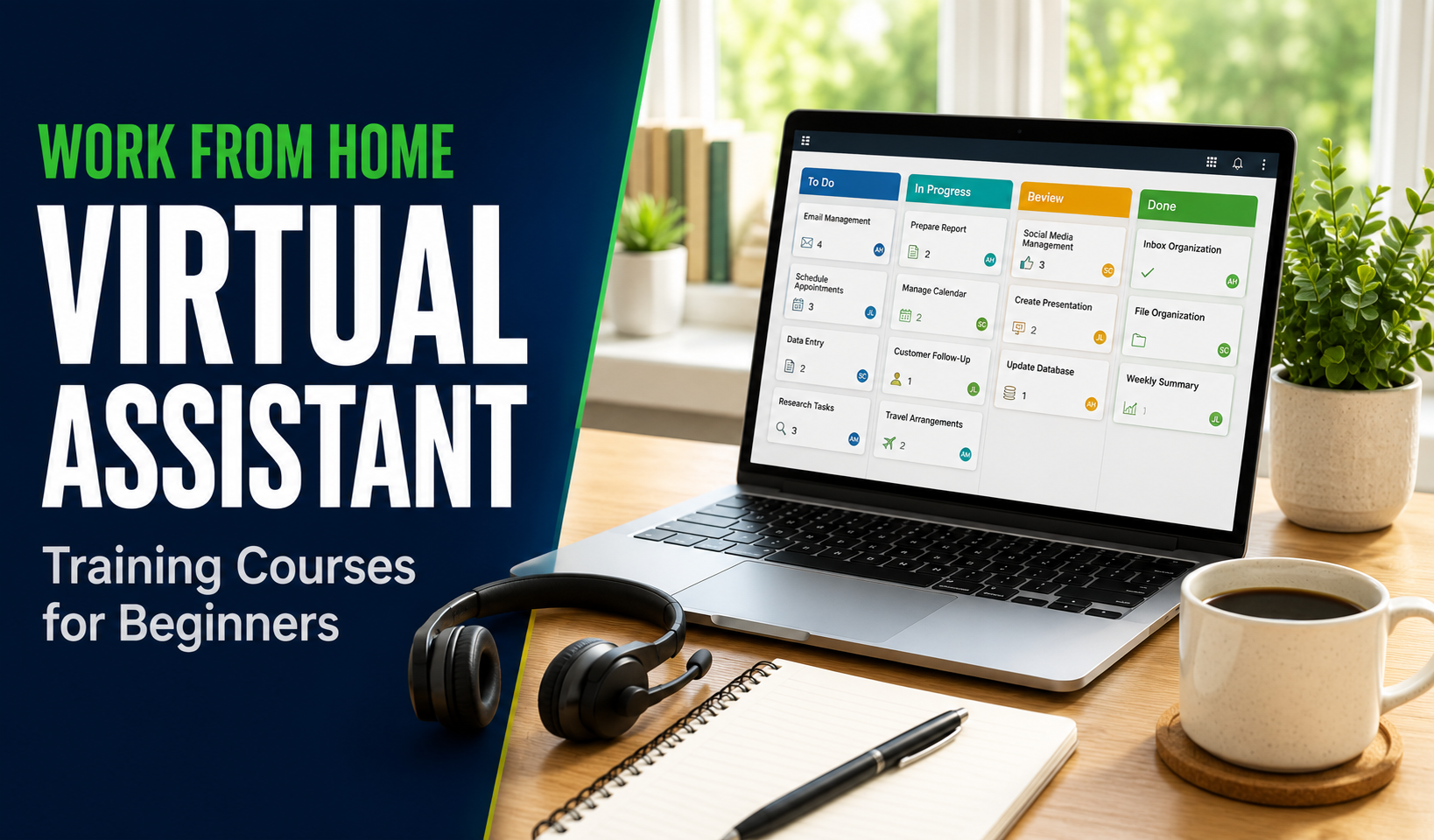
Becoming a virtual assistant is one of the fastest ways to start earning from home with no degree and no prior experience. Businesses everywhere are hiring VAs to handle email, scheduling, social media, and admin work, and you can learn the skills online in a weekend or build toward a specialized, higher-paying niche over a few months.
The tricky part is choosing a course. There are hundreds of them, ranging from cheap weekend crash courses to structured, months-long certificate programs, and they are not all trying to do the same thing.
This guide breaks down the top 5 for beginners, what each one actually teaches, what it costs, and which one fits your goal, whether that is landing your first client this month or building a career you can grow.
Disclosure: This post contains affiliate links. If you enroll or sign up through one of them, I may earn a small commission at no extra cost to you. I only recommend programs and tools I believe are genuinely worth it.
Quick comparison: the 5 best VA courses at a glance
| Course (Platform) | Price | Duration | Best For |
|---|---|---|---|
| Become a Virtual Assistant: Skills, Clients & Confidence (Udemy) | ~$15 to $30 on sale | A few hours | Landing your first clients fast |
| Must-Have Skills for Virtual Assistants (Udemy) | ~$15 to $30 on sale | A few hours | Learning the core skills clients expect |
| Virtual Assistant Course for Complete Beginners (Udemy) | ~$15 to $30 on sale | A few hours | Setting up your VA business |
| Google Project Management Certificate (Coursera) | ~$49/month | ~6 months (faster if full-time) | Specializing to charge more, learning Asana |
| Google Digital Marketing & E-commerce Certificate (Coursera) | ~$49/month | Several months self-paced | Becoming a higher-paid marketing VA |
The first three are budget Udemy courses that get you working fast. The last two are structured Coursera certificates that take longer and cost more, but credential you to specialize and command higher rates. Here is how to think about each.
How do I become a virtual assistant with no experience?
You do not need a degree, a certificate, or prior office work to start. What you need is a small set of practical skills (email and calendar management, basic research, organization, and comfort with a few software tools), plus the confidence to pitch yourself to clients. A good beginner course gives you all of that in a structured way so you are not guessing what clients actually want.
The honest truth about “get clients fast”: a course can hand you the framework, the templates, and the pitching scripts, but you still have to do the outreach.
The students who land clients quickly are the ones who finish the course and immediately start applying and pitching, not the ones who keep buying more courses. Treat the course as your launchpad, then take action.
The 3 best budget Udemy courses for beginners
Udemy is the smart starting point because the courses are cheap (the list prices look high, but Udemy runs near-constant sales that drop most courses to around $15 to $30), practical, and you own them for life. These three cover the full beginner journey.
1. Become a Virtual Assistant: Skills, Clients & Confidence
This is the most action-focused pick for getting paid quickly. It is short and practical, and it walks you through exactly what clients look for in a VA, how to present yourself professionally, and how to start finding and landing freelance clients.
It comes with templates and guided tasks, and it is built specifically for people with no prior experience. If your single goal is “land my first client as soon as possible,” start here.
2. Must-Have Skills for Virtual Assistants
Taught by Erin Booth, a working VA and one of the most respected trainers in this space, this course bridges the gap between what clients expect and what beginners actually know how to do.
It covers the bread-and-butter services: calendar management, inbox management, travel arrangements, social media upkeep, and how to handle the tricky situations that come up with clients.
Every section includes a downloadable resource, checklist, or quiz so you practice as you learn. This is the one to take if you want to feel genuinely competent before you take on a paying client.
3. Virtual Assistant Course for Complete Beginners
If the business side intimidates you, this one focuses on setup. It walks you step by step through choosing your services, setting up your online presence, writing proposals, and landing clients.
It is ideal for someone who knows they can do the work but has no idea how to actually start a freelance business. Pair it with course #1 above and you have both the “how to do the work” and “how to run the business” sides covered for under $60 total.
The 2 best Coursera certificates for VAs who want to earn more
Here is where the strategy gets interesting. The Udemy courses teach you to be a general VA, and general admin VAs typically charge $15 to $25 an hour.
But specialized VAs (project management, operations, marketing) charge $35 to $60 an hour and up. The fastest way to jump from generalist pay to specialist pay is a recognized credential in a high-value skill. That is what these two Coursera certificates give you.
They cost more than a Udemy course, around $49 a month on a Coursera subscription, and take a few months rather than a few hours. But they end with a real, employer-recognized credential and a portfolio project, which is exactly what lets you raise your rates.
4. Google Project Management Professional Certificate
This is my top pick for any VA who wants to grow. Project coordination is one of the most in-demand and best-paid VA specialties, and this certificate teaches it from scratch with no experience required.
Critically for VAs, it teaches you to use Asana, the project management tool tons of clients use to organize work, along with other common work-management platforms.
It is a six-course program, usually finished in about six months at 10 hours a week (faster if you push), and it ends with a capstone project you can show clients. Add “skilled in project planning and Asana” to your pitch and you are no longer competing on price with every other beginner.
Explore the Google Project Management Certificate on Coursera
5. Google Digital Marketing & E-commerce Professional Certificate
Marketing is the other high-value VA niche. Clients happily pay more for a VA who can run their email campaigns, manage social media strategically, or help with e-commerce, rather than just scheduling posts.
This Coursera certificate follows the same beginner-friendly, no-experience model as the PM one, on the same monthly subscription, and turns you into a “marketing VA” who can charge specialist rates.
If you enjoy the creative and growth side of business more than the admin side, this is your path.
Explore the Google Digital Marketing Certificate on Coursera
What tools do virtual assistants use?
Clients often expect you to already know the common tools, so getting comfortable with a few of these makes you instantly more hireable. Most offer free plans you can learn on before a client ever asks.
- Asana is one of the most widely used project and task management tools, and knowing it is a real selling point. You can start free and practice organizing your own tasks before using it with clients. Try Asana here
- Google Workspace (Docs, Sheets, Calendar, Gmail) is the backbone of most VA work.
- Trello or ClickUp are popular alternatives to Asana, useful to have basic familiarity with.
- Canva is essential if you offer any social media or light design help.
- Calendly for scheduling, and a password manager for handling client logins securely.
A quick tip: pick one project tool (Asana is a safe bet) and get genuinely comfortable with it rather than dabbling in five. Depth beats breadth when a client asks “do you know Asana?”
How do virtual assistants get clients?
This is the question that matters most, because skills without clients do not pay the bills. The most reliable starting paths for beginners are freelance marketplaces and direct outreach.
Set up a profile on the major freelance platforms, apply consistently to entry-level VA gigs, and pitch small business owners directly in your niche. Your course templates and a simple portfolio (even practice projects count) are enough to start.
The VAs who get clients fast share one habit: they pitch in volume early on, accept that the first few rates may be modest, collect a few strong reviews, and then raise their rates.
Specializing accelerates this, since it is far easier to stand out as “an Asana project management VA for coaches” than as a generic “virtual assistant.”
How much do virtual assistants make?
Let us be realistic with the numbers. Beginner general admin VAs typically charge $15 to $25 an hour. The average freelance VA charges somewhere around $25 to $35 an hour, and US-based VAs average roughly $35 an hour.
Specialized VAs (executive assistance, project management, marketing) commonly command $35 to $60 an hour, and niche experts can charge $50 to $75 or more.
Two patterns are worth noting. VAs who specialize earn meaningfully more than generalists, often several dollars more per hour, which adds up to hundreds of extra dollars a month for full-time work.
And VAs who price by the project rather than purely by the hour tend to earn more overall. The takeaway: start as a generalist to get experience and clients, then specialize to raise your ceiling.
Do you need a certification to be a virtual assistant?
No. There is no required license or certification to work as a VA. A cheap Udemy course is plenty to start landing general admin clients.
Where a certificate helps is in specializing and charging more: a recognized credential like the Google Project Management certificate signals real skill and justifies higher rates.
So the practical answer is start without one, then earn a credential strategically once you know which niche you want to grow into.
If you’d rather go the credentialed route from the start, bookkeeping is another strong no-degree option worth comparing.
Frequently asked questions
Which VA course is best for a complete beginner?
For getting started fast and cheap, “Become a Virtual Assistant: Skills, Clients & Confidence” on Udemy is the most action-focused pick.
Pair it with a setup-focused course and you have both the skills and the business basics covered for a small one-time cost.
Is Udemy or Coursera better for virtual assistant training?
They serve different goals. Udemy is cheaper, faster, and great for learning practical VA skills and getting your first clients.
Coursera costs more and takes longer, but its structured certificates credential you to specialize and charge higher rates. Many VAs use both: Udemy to start, Coursera to level up.
How long does it take to become a virtual assistant?
You can learn the basics from a Udemy course in a weekend and start pitching clients within days. Building a specialized, higher-paid skill set through a Coursera certificate takes a few months. Both are achievable around a full-time job.
Can I make a full-time income as a virtual assistant?
Yes. Plenty of VAs work full-time, and specialized VAs in project management or marketing can build a strong income, especially once they price by the project and develop repeat clients. It takes consistent client outreach to get there, but the ceiling is real.
What is the easiest VA service to start with?
General administrative support (inbox management, calendar scheduling, data entry, basic research) has the lowest barrier to entry. As you gain confidence, add a specialty like project coordination or social media to raise your rates.
Disclaimer: Course prices and pay figures are based on publicly available information as of 2026 and can change. Udemy list prices fluctuate and courses are frequently discounted, so always check the current price before enrolling, and confirm Coursera pricing on the official program page. Income and rate ranges vary by experience, location, niche, and effort, and are not guarantees. This article is educational and not financial or career advice. It contains affiliate links, and I may earn a commission if you sign up through them at no additional cost to you.
Ready to start? The fastest first step is a practical beginner course like Become a Virtual Assistant on Udemy, then specialize with the Google Project Management Certificate on Coursera once you are ready to raise your rates.