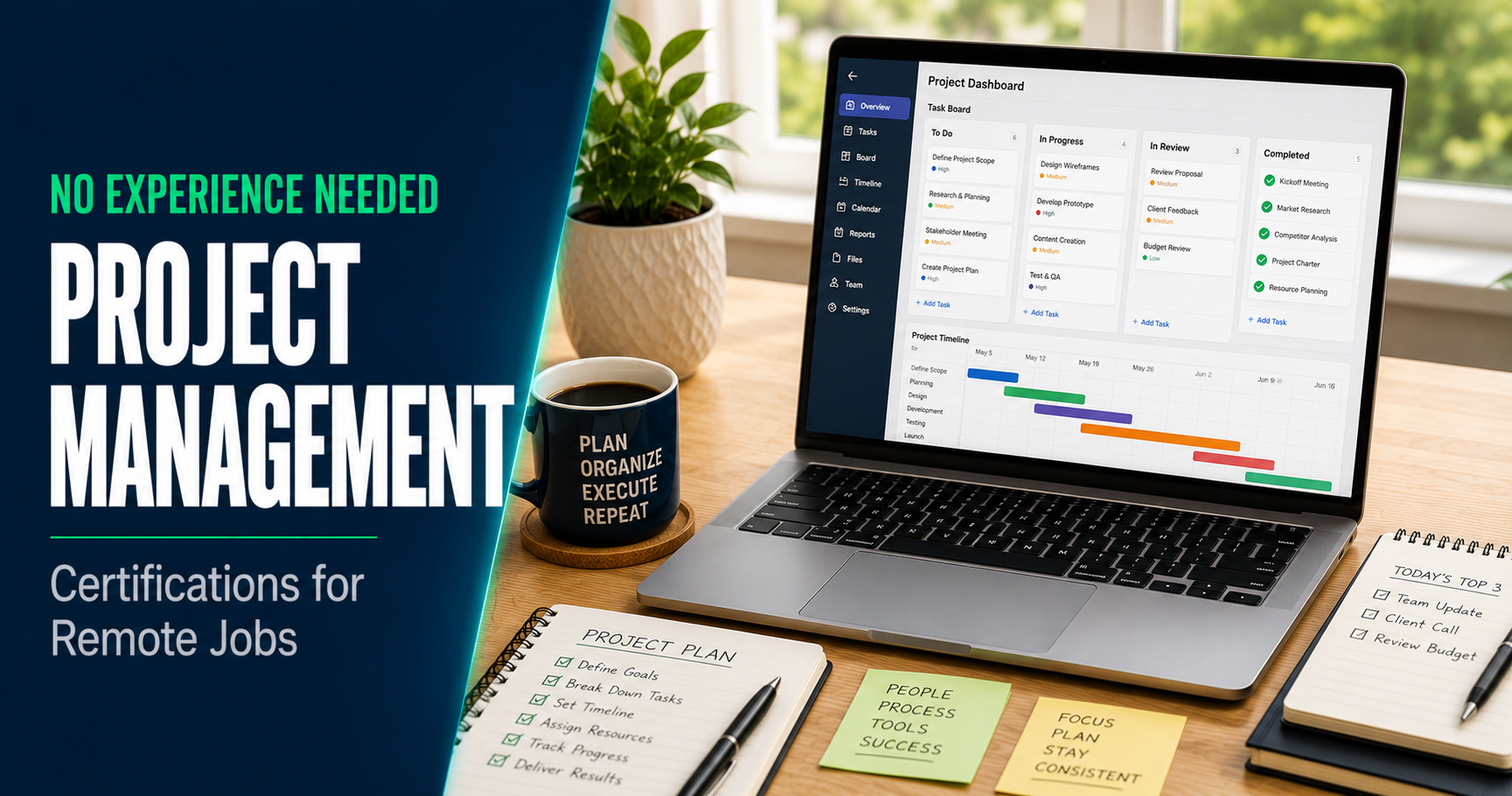
Project management is one of the most realistic ways to pivot into a well-paid, remote-friendly career, even if you have never held a “project manager” title. There are over 464,000 open PM jobs in the US, the entry-level median sits around $87,000, and a lot of the work is done remotely. The right project management certification courses can take a complete beginner with no corporate experience and give them the language, skills, and credibility to land that first role.
The two options most beginners weigh are the Google Project Management Certificate and the CAPM. They sound similar, but they are built for different jobs, and understanding the difference is the key to spending your time and money well.
This guide compares them, explains the Agile and Scrum skills that actually get you hired in 2026, and lays out the smartest path from beginner to employed.
Disclosure: This post contains affiliate links for Coursera and Udemy. If you enroll through one, I may earn a small commission at no extra cost to you. I only recommend programs I believe are genuinely worth it.
Quick comparison: the top beginner PM credentials
| Option | Price | Duration | Best for |
|---|---|---|---|
| Google Project Management Certificate (Coursera) | ~$49/month (~$150 to $300 total) | 3 to 6 months | Learning the skills and building a portfolio |
| CAPM Certification (PMI exam) | ~$225 to $300 exam, plus prep | 6 to 8 weeks of study | A recognized credential recruiters screen for |
| CAPM Exam Prep (Udemy) | ~$15 to $30 on sale | Self-paced | Affordable preparation for the CAPM exam |
The single most useful thing to understand before choosing is what kind of thing each one is, so let us start there.
Certificate vs certification: the difference that matters
This is the distinction that trips up almost every beginner.
A certificate says you completed a learning program. The Google Project Management Certificate is course-based: you earn it by finishing the lessons, quizzes, and assignments, with no separate proctored exam. It proves you learned the material.
A certification says you met a standard and passed an exam. The CAPM (Certified Associate in Project Management) from PMI is earned by passing a proctored exam against a defined body of knowledge. It proves you can demonstrate that knowledge under test conditions, which is why recruiters who know PMI tend to read it as stronger professional readiness.
Neither is “better” in the abstract. They do different jobs, and the smartest beginners often use both in sequence. Here is how each works.
Is the Google Project Management Certificate worth it?
For a beginner with no experience, yes, it is one of the best-value entry points available. The Google Project Management Professional Certificate is a self-paced program on Coursera that most people finish in three to six months at around ten hours a week, for roughly $150 to $300 total depending on your pace. No degree or experience is required, since Google built it specifically for career changers.
What you get is genuinely useful: structured training in both traditional (predictive) and Agile project management, hands-on practice building real artifacts like project charters, schedules, risk registers, and RACI charts, and a capstone project that becomes a portfolio piece.
It teaches common tools like Asana and Google Workspace, carries real brand recognition with hiring managers, and reports strong positive career outcomes for graduates.
There is an important bonus for your next step: the program counts toward 100+ hours of PM education, which far exceeds the 23 hours PMI requires to sit the CAPM exam. So finishing the Google certificate makes you immediately eligible for the CAPM.
The honest catch: this certificate opens the door, but it rarely appears as a hard requirement in job postings on its own, and you will still need to prove real capability in interviews.
It teaches Asana and Google Workspace, while many job ads also mention Jira or Microsoft Project, so plan to pick those up as you go. Treat it as a strong starting point, not a golden ticket.
This is the same Google credential we recommend in our guide to virtual assistant training for VAs who want to specialize, because project coordination skills are valuable across many remote roles.
Explore the Google Project Management Certificate on Coursera
CAPM and Udemy exam prep: the recognized credential
If you want a credential that recruiters specifically recognize and screen for, the CAPM is the entry-level PMI certification to target. Unlike the PMP (which requires years of experience), the CAPM only requires a high school diploma and 23 hours of PM education, which the Google certificate already gives you. The exam runs about $225 to $300 depending on PMI membership, with roughly 150 questions covering predictive, Agile, and business analysis approaches.
You do not need an expensive bootcamp to prepare. Udemy has affordable CAPM exam prep courses and practice tests, usually on sale for around $15 to $30, that walk you through the exam content and let you drill realistic practice questions before test day. Pairing a Udemy prep course with the free practice exams floating around the PMI ecosystem is a low-cost, effective way to get ready.
On a resume, the CAPM tends to carry more weight than a course certificate alone because it is a recognized PMI credential, and it is your foothold in the PMI ecosystem if you later pursue the PMP.
What is the difference between Agile and Scrum?
Since mastering these is the key to pivoting into modern PM roles, here is the plain-English version.
Agile is the mindset and philosophy. It is an approach to managing work that values flexibility, delivering in small increments, and adapting to change rather than following one rigid upfront plan. Agile is the umbrella.
Scrum is a specific framework for doing Agile. It is one popular way to put Agile into practice, with defined roles (Product Owner, Scrum Master, and the development team), set events or ceremonies (sprint planning, daily standups, sprint reviews, retrospectives), and artifacts like the product backlog and user stories.
A simple way to hold it: Agile is the “why and what” (the values), and Scrum is a structured “how” (the rules and roles for running the work). You will also hear about Kanban, another Agile framework focused on visualizing work on a board.
Most workplaces in 2026 run a hybrid of traditional and Agile approaches, which is exactly what a good beginner program teaches. The Google certificate dedicates a full course to Agile and Scrum, which is its single biggest differentiator and the part most relevant to today’s remote PM jobs.
Can you become a project manager with no experience?
Yes, and this field is unusually friendly to career changers. The trick is recognizing that you have probably already done informal project management: organizing a team, coordinating a timeline, managing a launch or an event. A certificate plus that reframed experience is a legitimate starting point.
Most people with no corporate background do not start with the “Project Manager” title. They start as a Project Coordinator, Junior PM, Project Analyst, Program Coordinator, or Operations Associate, then grow into full PM roles. Build a portfolio from your capstone and any real coordination work, learn Agile and Scrum well, and apply to those entry-level titles rather than senior ones.
How to choose project management certification courses as a beginner
With the main options clear, here is how to pick the right project management certification courses for your situation:
- Start with the Google certificate if you need to learn the actual skills, want a portfolio, and prefer the lowest upfront cost. Best for true beginners.
- Add the CAPM when you want a recognized credential that recruiters screen for, using your Google education hours to qualify, and prep affordably on Udemy.
- Look toward the PMP later, once you have a few years of experience. It is the gold-standard credential, but it is not a beginner option.
The most effective beginner path is Google certificate first, CAPM second, PMP eventually. Each one builds on the last at the right career stage. For a broader look at how the learning platforms themselves compare, see our guide on Coursera vs Udemy for remote job skills.
How much do remote project managers make?
The pay is a big draw. Entry-level project management roles carry a median around $87,000, which is strong for a career you can enter without a degree or prior PM title. Project coordinators and junior PMs typically start lower and climb quickly as they gain experience and certifications.
The field is large and growing, with hundreds of thousands of open roles, and project management translates well to remote work since so much of it is planning, coordination, and communication done through digital tools. As you move from coordinator to PM to senior PM, and especially once you add the PMP later, earning potential rises substantially.
Frequently asked questions
Is the Google Project Management Certificate or CAPM better?
They serve different goals. The Google certificate is better for learning the skills, building a portfolio, and starting cheaply. The CAPM is better as a recognized credential that recruiters screen for. Many beginners do the Google certificate first, then use it to qualify for the CAPM.
Do you need a certification to become a project manager?
Not strictly, but for a beginner with no experience, a certification is one of the fastest ways to gain credibility and get past resume screening. It signals you understand PM concepts and tools.
How long does it take to get project management certified?
The Google certificate takes most people three to six months part-time. CAPM exam prep typically takes another six to eight weeks of focused study. A realistic beginner timeline from zero to CAPM is around six to nine months.
Can I get a remote project management job with just a certificate?
A certificate helps you get interviews, but you will also need to demonstrate real capability and ideally a portfolio. Reframe any past coordination work, build your capstone into a portfolio, and target entry-level titles like project coordinator first.
Which is more important to learn, Agile or Scrum?
Learn both, because they connect. Agile is the overall mindset and Scrum is the most common framework for applying it. Most modern PM roles expect familiarity with Agile principles and Scrum practices, which good beginner courses cover together.
Disclaimer: Course prices, exam fees, and salary figures are based on publicly available information as of 2026 and can change, so confirm current pricing on the official Coursera, Udemy, and PMI pages before enrolling. Salaries vary by role, experience, location, and employer and are not guarantees of income or employment. This article is educational and not financial or career advice. It contains affiliate links, and I may earn a commission if you enroll through them at no additional cost to you.
Ready to start? Build the skills and a portfolio with the Google Project Management Certificate on Coursera, then turn it into a recognized credential with CAPM exam prep on Udemy.