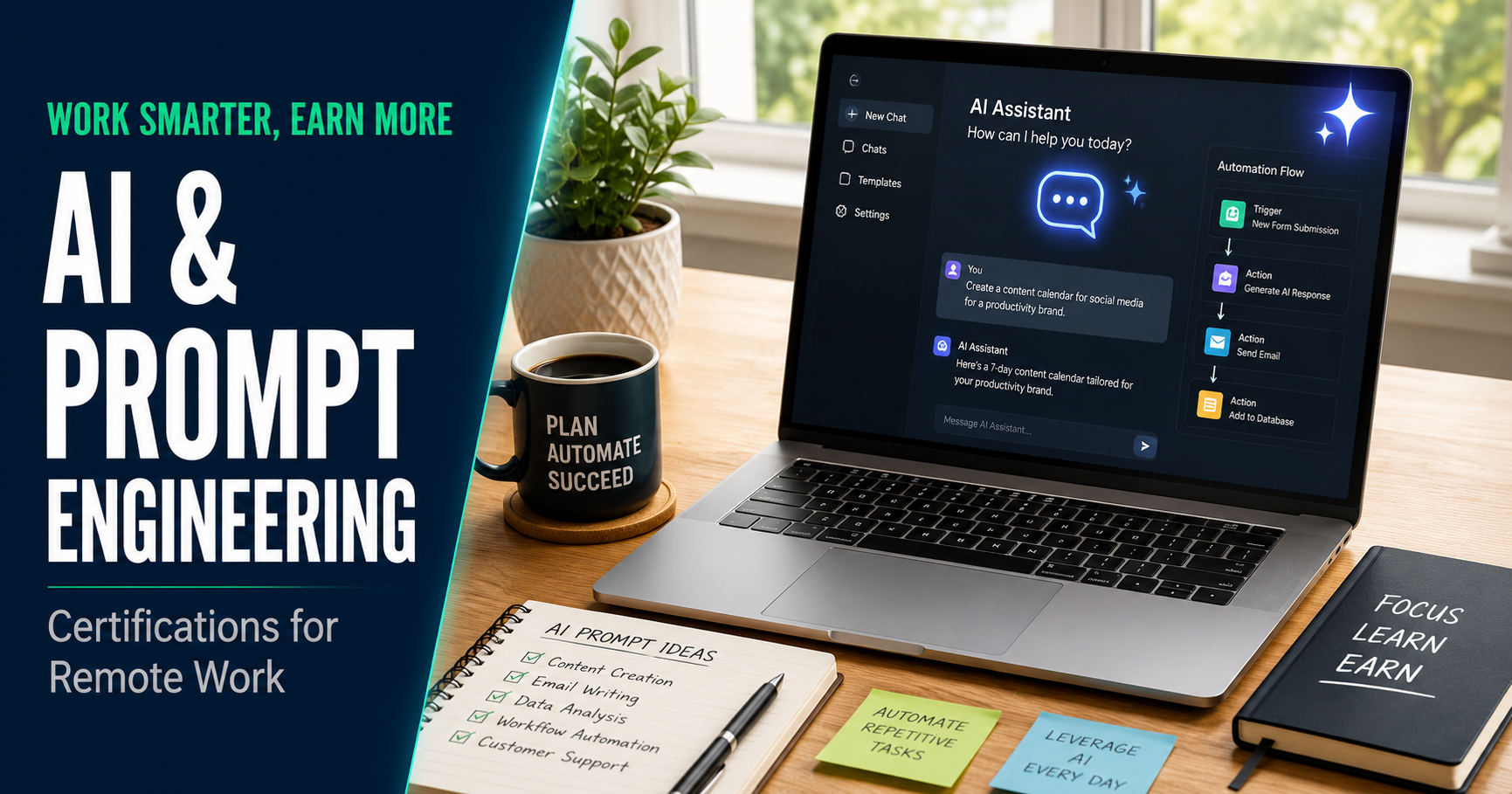
AI tools like ChatGPT and Claude have quietly become the most valuable skill a remote worker can add right now. If you are a virtual assistant, an office admin, or anyone who does knowledge work from home, learning to use AI well does not just make your day easier. It makes you measurably more productive, lets you offer more services, and gives you a real reason to raise your rates. The best AI and prompt engineering certifications can take you from casually typing questions into ChatGPT to confidently automating chunks of your workflow.
Let me set honest expectations first, because the AI space is full of hype. This is not about becoming a $200,000 “prompt engineer,” which is a different, more technical career. This is about a practical, achievable goal: learning to use AI tools so well that you become the obvious choice for remote admin work and can charge a premium for it. This guide compares the top courses, the free options worth knowing about, and exactly how these skills translate into higher pay.
Disclosure: This post contains affiliate links for Coursera and Udemy. If you enroll through one, I may earn a small commission at no extra cost to you. I only recommend courses I believe are genuinely worth it.
Quick Comparison: The Best AI Courses For Remote Workers
| Course | Price | Duration | Best for |
|---|---|---|---|
| Vanderbilt Prompt Engineering Specialization (Coursera) | ~$49/month | About 1 month | A credible, structured foundation |
| The Complete Prompt Engineering AI Bootcamp (Udemy) | ~$15 to $20 on sale | Self-paced | Practical, tool-by-tool projects |
| Top-rated ChatGPT Mastery course (Udemy) | ~$15 to $20 on sale | Self-paced | A quick, non-technical start |
| Free path (DeepLearning.AI, Anthropic docs, Learn Prompting) | Free | Self-paced | Budget learners and testing the waters |
Before the breakdown, one quick reality check on certificates in this field, because it shapes how you should spend your money.
Are Prompt Engineering Certifications Worth it?
Honest answer: yes, but with the right expectations. Prompt engineering is a genuinely valuable skill, but it is also a new field, so its certifications do not carry the same universally recognized weight as, say, a project management or cloud certification. No single prompt engineering certificate is an industry standard yet.
What a recognized certificate does do is signal that you invested in structured learning, which separates you from the crowd of people who claim “AI skills” based on casual ChatGPT use. The Vanderbilt certificate on Coursera is recognized by AI-aware hiring managers for exactly this reason.
The most important takeaway: a strong portfolio of real AI work beats a stack of certificates with nothing to show. The winning approach is to get one solid certificate, then immediately build a few examples of AI workflows you have automated, prompts you have engineered, or tasks you have sped up. Keep that in mind as you choose below.
Vanderbilt Prompt Engineering Specialization: the credible foundation
If you want a structured, credible introduction with a recognizable name attached, this is the standout pick. The Prompt Engineering Specialization on Coursera is offered by Vanderbilt University and taught by Dr. Jules White, whose pattern-based approach to prompting has been widely adopted across the field. It requires no programming or prior AI knowledge, just a free ChatGPT account.
It is a three-course specialization that teaches reusable “prompt patterns” (like the persona, template, and flipped-interaction patterns), more advanced techniques such as chain-of-thought reasoning, and how to use ChatGPT as a genuine productivity and problem-solving tool. Most people finish in about a month, and it runs on a Coursera subscription of roughly $49 a month. You can audit the videos for free if you only want the knowledge, and apply for financial aid if cost is a barrier.
For a remote admin worker or VA, the value is direct: you learn a repeatable system for getting consistent, high-quality results out of AI, instead of guessing at prompts and hoping. That consistency is exactly what lets you take on AI-assisted work for clients with confidence.
Explore the Vanderbilt Prompt Engineering Specialization on Coursera
Udemy AI bootcamps: The Practical, Tool-Focused Route
If you would rather learn by doing, hands-on with the actual tools, Udemy is the cheaper and more practical option. The list prices look high, but Udemy runs sales every couple of weeks that drop courses to around $15 to $20, and you keep them for life.
The standout is a comprehensive AI prompt engineering bootcamp that works through real-world projects across multiple tools, ChatGPT, Midjourney for images, and others, using a clear set of prompting principles. There are also excellent, top-rated general ChatGPT mastery courses that are perfect for a complete beginner who just wants to get productive fast without any technical depth.
Two honest notes on Udemy. Quality varies a lot between instructors, so check that a course has recent reviews mentioning current AI models before you buy, since “updated for 2026” sometimes just means one new video was bolted onto older material. And Udemy certificates carry less name recognition than the Vanderbilt one. The tradeoff is cost and practicality: for the price of lunch, you get hands-on practice you own forever.
The Free Path (worth knowing about)
Because this field is new, some of the best learning is free. DeepLearning.AI offers a well-known free ChatGPT prompting course taught by Andrew Ng, Anthropic publishes free documentation on prompting Claude effectively, and Learn Prompting is a free, open-source guide from basics to advanced.
If you are on a tight budget or just testing whether this interests you, the free path plus a portfolio of practice projects is genuinely sufficient to build real skill. Pay for a certificate when you want the credential to show, not because you cannot learn without it.
Which AI Tools Should a Remote Worker Learn?
For admin and VA work specifically, you do not need to learn everything. Focus on a few high-impact tools:
- ChatGPT and Claude are the workhorses. Use them to draft and reply to emails, summarize long documents and meetings, write and edit content, brainstorm, organize information, and build templates. These two cover the majority of remote admin tasks, and getting genuinely good at prompting them is where most of your value comes from.
- Midjourney (or similar image generators) is worth basic familiarity if you offer any social media or content help, since clients increasingly want simple custom visuals.
- An automation tool like a no-code workflow builder is a bonus once you are comfortable, letting you connect AI to the apps you already use.
A practical tip: go deep on ChatGPT or Claude first rather than dabbling across ten tools. Being the VA who can genuinely automate a client’s email triage or document summaries is worth more than knowing a little about everything. These AI skills pair especially well with the broader skills in our guide to virtual assistant training courses.
Can Learning AI Actually Help Me Charge Higher Rates?
Yes, and here is the honest mechanism, because it is not magic. AI does not make a client pay you more just for having a certificate. It makes you more valuable in two concrete ways.
First, productivity. A worker who uses AI well can be dramatically more efficient, which means you deliver more in less time. If you charge by the project or the outcome rather than purely by the hour, that efficiency goes straight into your earnings.
Second, expanded services. Once you can use AI confidently, you can offer things a non-AI VA cannot: fast content drafts, document and meeting summaries, data cleanup, simple image creation, and workflow automation.
Those are higher-value services that justify higher rates. You are no longer “a VA who answers emails,” you are “a VA who can automate parts of your business,” which is a different conversation about price.
The grounded version: the certificate gets your foot in the door, but it is the demonstrated ability to save clients time and do more that lets you command a premium.
How to choose AI and prompt engineering certifications
With the options clear, here is how to pick the right AI and prompt engineering certifications for your situation:
- Want a credible, structured foundation with a recognizable name? The Vanderbilt specialization on Coursera.
- Want cheap, hands-on, tool-by-tool practice? A Udemy AI bootcamp on sale.
- On a tight budget or just exploring? Start with the free path, then add a certificate later.
- Whatever you choose, build a small portfolio of real AI workflows. That is what actually moves your rates.
For a broader comparison of the two main platforms, see our guide on Coursera vs Udemy for remote job skills.
Frequently asked questions
Do you need a certification to use AI for remote work?
No. You can learn to use AI tools well through free resources and practice. A certificate helps you signal the skill to clients and employers, but your demonstrated ability matters more than any credential in this field.
Is prompt engineering still in demand in 2026?
Yes, though the framing has shifted. Dedicated “prompt engineer” job titles are more technical and competitive, but the broader skill of using AI productively is now in demand across almost every remote role. For admin and VA work, it is quickly becoming an expected skill rather than a niche one.
Can a beginner with no tech background learn this?
Absolutely. The best beginner courses, including the Vanderbilt specialization, require no programming. If you can use a chat app, you can learn to prompt AI effectively. It is one of the most accessible high-value skills available right now.
Coursera or Udemy for AI courses?
Coursera (Vanderbilt) offers a more credible, structured credential. Udemy offers cheaper, more practical, hands-on courses. Many people audit or take a Udemy course to learn fast, then add the Vanderbilt certificate for the resume.
How long does it take to learn prompt engineering?
You can learn the fundamentals in a few weeks of focused study. The Vanderbilt specialization takes about a month, and a Udemy course can be done faster. Building real fluency comes from applying it to your actual work daily.
Disclaimer: Course prices are based on publicly available information as of 2026 and change frequently, especially Udemy sale prices and Coursera promotions, so confirm current pricing before enrolling. Pay outcomes vary widely by skill, services offered, and effort, and are not guarantees of income. This article is educational and not financial or career advice. It contains affiliate links, and I may earn a commission if you enroll through them at no additional cost to you.
Ready to start? Build a credible foundation with the Vanderbilt Prompt Engineering Specialization on Coursera, or learn hands-on for less with a practical AI course on Udemy, then put your new skills to work and build a portfolio.